English
English
Español
Português
русский
français
日本語
Deutsch
Tiếng Việt
Italiano
Nederlands
ไทย
Polski
한국어
Svenska
magyar
Malay
বাংলা
Dansk
Suomi
हिन्दी
Pilipino
Türk
Gaeilge
عربى
Indonesia
norsk
اردو
čeština
Ελληνικά
Українська
Javanese
فارسی
தமிழ்
తెలుగు
नेपाली
Burmese
български
ລາວ
Latine
Қазақ
Euskal
Azərbaycan
slovenský
Македонски
Lietuvos
Eesti Keel
Română
Slovenski
मराठी
Српски
Esperanto
Afrikaans
Català
עִברִית
Cymraeg
Galego
Latvietis
icelandic
יידיש
Беларус
Hrvatski
Kreyòl ayisyen
Shqiptar
Malti
lugha ya Kiswahili
አማርኛ
Bosanski
Frysk
ជនជាតិខ្មែរ
ქართული
ગુજરાતી
Hausa
Кыргыз тили
ಕನ್ನಡ
Corsa
Kurdî
മലയാളം
Maori
Монгол хэл
Hmong
IsiXhosa
Zulu
Punjabi
پښتو
Chichewa
Samoa
Sesotho
සිංහල
Gàidhlig
Cebuano
Somali
Точик
O'zbek
Hawaiian
سنڌي
Shinra
հայերեն
Igbo
Sundanese
Lëtzebuergesch
Malagasy
Yoruba
Javanese
Banbala
Pokjoper
Divih
Philippine
Gwadani
Elokano

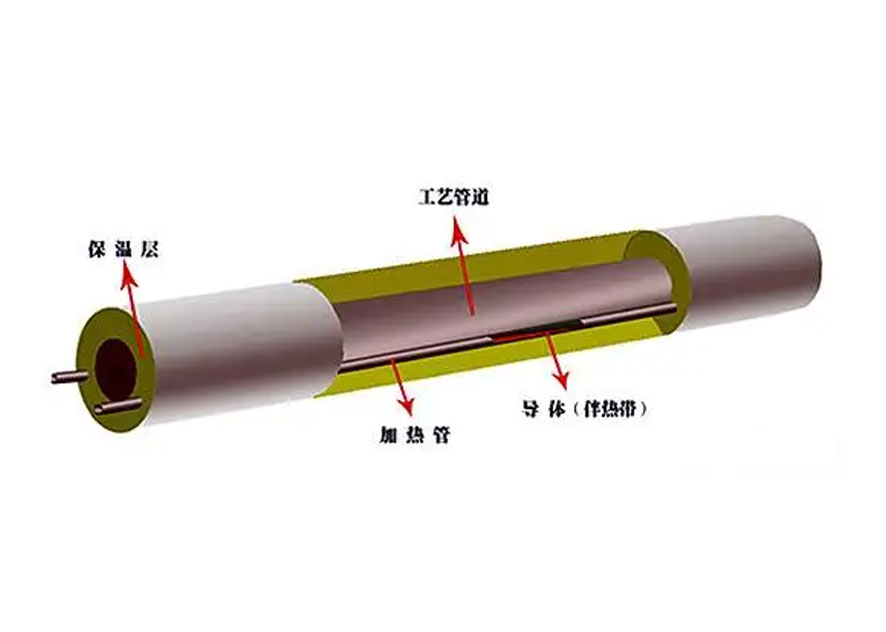
Local overheating of electric heat tracing systems is a common operational hazard, often caused by non-standard construction and installation, improper selection of operating conditions, and unreasonable insulation protection. Mild cases can accelerate cable insulation aging and shorten equipment life, while severe cases can cause safety issues such as short circuits and fires. Standardizing construction and operation methods can effectively avoid local overheating hazards and ensure the safe and stable operation of the system.

Eliminating overlapping and cross laying is the fundamental point to avoid overheating. Both self limiting temperature and constant power electric heat tracing belts are prohibited from overlapping, winding, or stacking for installation. Some constructions are carried out at will to avoid unnecessary cross wiring, and the heat in overlapping areas cannot be dissipated, resulting in local heat accumulation and high temperature zones. The overlapping of self limiting temperature bands will trigger passive power limiting, resulting in uneven heating and cooling; The constant power heat tracing belt continuously generates heat, and the accumulated heat can easily damage the insulation sheath. During construction, cables must be arranged in a parallel and orderly manner, without crossing or stacking throughout the entire process, and strictly laid according to standard spacing.
Standardize the laying method of special points and eliminate high temperature blind spots. Pipeline valves, flanges, tees, and elbows dissipate heat quickly, and additional cables are often added during construction. However, excessive winding and dense stacking can cause local overheating in the opposite direction. For this type of accessory, it is necessary to use loose wrapping and uniform supplementation to supplement heat, and it is forbidden to wrap tightly with small radii. At the same time, cables must not be tightly attached to pipeline welds or high-temperature protrusions to avoid double heat accumulation, which may cause local temperature exceeding the standard and damage equipment.
Strictly control the quality of insulation and external protection construction to prevent heat accumulation in a sealed environment. The insulation layer is too thick, the covering is too dense, the sealing is tight and there is no heat dissipation space, or the insulation cotton is damp, clumped, hollow and compacted, which can cause the heat generated by the heat tracing belt to be unable to dissipate normally and continue to accumulate, forming a high-temperature zone. Construction requires the use of insulation materials with appropriate thickness to ensure that the insulation layer is flat, loose, dry, and breathable, and to prevent local compaction and sealing. Reasonable gaps should be reserved for the installation of outdoor pipeline outer protective plates to avoid completely enclosed wrapping and heat storage overheating.
Accurately select and match working conditions to avoid overheating caused by mismatched working conditions. Different scenarios require corresponding models of heat tracing belts. Conventional models can be used for low-temperature ordinary pipelines. If high-power and high-temperature cables are blindly selected, continuous full load heating under normal working conditions can easily cause overheating and aging. At the same time, for enclosed narrow tanks and small diameter pipelines, low-power adapters should be selected, and high-power cables should not be laid in small areas to avoid local overheating caused by excessive power from the selection end.
Standardize circuit and temperature control settings to balance the overall temperature. Continuous power supply without temperature control, excessive single circuit load, and unstable line voltage can all lead to long-term overheating in certain areas. The project requires intelligent temperature controllers and temperature sensors to accurately control temperature, start and stop as needed, and avoid continuous idle heating of the equipment. The sensor should be installed in close proximity to the low-temperature point of the pipeline, and should not be suspended or offset to prevent temperature distortion from causing continuous heating and local overheating. At the same time, divide the circuit reasonably to prevent excessive load on a single pipeline segment.
Daily refined inspections to identify potential overheating hazards in advance. Focus on inspecting the corners of pipelines, winding areas of fittings, and insulation sealed sections that are prone to passing through hot spots, and check whether the cables are aging, deformed, or if the protective sheath is hot. Promptly rectify issues such as wiring disorder, insulation water accumulation, and cable compression, regularly check circuit current and insulation status, and avoid hidden overheating faults in advance.
The problem of local overheating in electric heat tracing can be comprehensively avoided through standardized installation, precise selection, standard insulation, intelligent temperature control, and regular inspections. Implementing various practical skills can not only eliminate safety hazards, but also delay equipment aging, extend the service life of electric heating systems, and achieve long-term stable operation.